Soot does not stay where the fire was. It rides the smoke into other rooms and settles on paint, carpet, upholstery, curtains and clothing. That is why a bedroom at the far end of the hall can need soot removal when nothing in it burned. For the whole job, from securing the house to rebuilding, see our page on fire damage restoration in Chula Vista.
How soot removal works after a house fire
Los Angeles County Public Health sets out the sequence, and the University of Florida's disaster handbook gives the same advice about fabric:
- Air the house out and clear the burned debris. Both cut the odor before any cleaning starts.
- Take loose soot off dry. Soot is oily. On fabric, a vacuum nozzle is held just above the surface, and brush attachments and upright vacuums are kept away because they force soot into the fibers.
- Use a dry chemical sponge on porous surfaces: paint, wallboard, plaster, wallpaper and bare wood. Getting soot off dry keeps it from being pushed deep into the surface, where it shows as a permanent stain.
- Then wash with a mild detergent, one small area at a time, working up the wall from the floor so drips do not streak. Ceilings go last, and nothing is repainted until everything is completely dry.
Heavy residue is a different job. The county lists methods that need a professional and equipment: sodium bicarbonate blasting, dry ice blasting, low-pressure sandblasting, steam power washing, and chemical application with agitation.
Timing matters on metal too. The University of Florida handbook says smoke can etch brass or copper within 24 hours, which is why those pieces come out and get cleaned early.
Why the kind of fire changes the cleanup
Los Angeles County Public Health says the type of fire decides the cleaning technique. Its fact sheet ties the method to what the fire left behind:
| What the residue is | What the source says it means for cleaning | Source, and the date it was checked |
|---|---|---|
| Dry, dusty soot | Typical of high-oxygen fires that spread fast; start with dry chemical sponges, then a mild detergent | Los Angeles County Department of Public Health, fact sheet rev. Jan 23, 2025. Checked Sep 26, 2026 |
| Oily soot on fabric | Soot is oil; brushes and beater bars force it into other belongings, so it is vacuumed with the nozzle held off the surface | Same fact sheet. Checked Sep 26, 2026 |
| Kitchen fire residue | May not be readily visible, so cleaning has to be thorough, and cabinets and drawers usually have to be emptied | Same fact sheet. Checked Sep 26, 2026 |
| Acidic soot on white paint and PVC | Can react with moisture in the air and stain for good, so these surfaces get a mild detergent early | Same fact sheet. Checked Sep 26, 2026 |
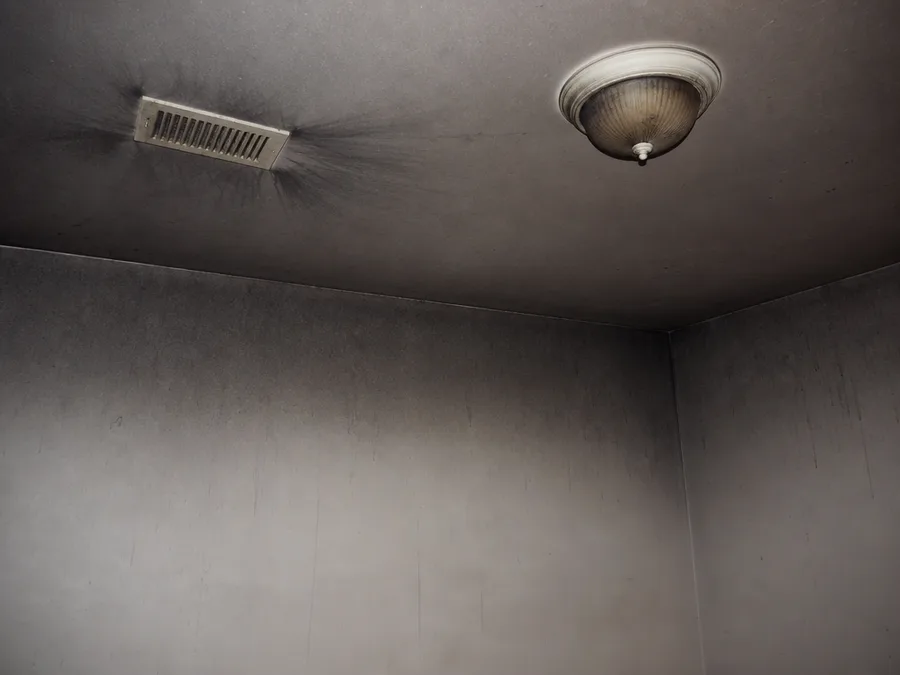
How do you remove soot from walls, fabric and air ducts?
Walls and ceilings get the dry sponge first, then a detergent wash from the bottom up, ceilings last. The county fact sheet adds that where a stain will not wash out, a paint made to stop bleed-through is used over it. Tile, sealed wood, glass and metal are less porous and take an ordinary household detergent.
With clothes and bedding, smoke odor stays in fabric until the unburned chemicals are washed out, and many of those are invisible. The University of Georgia's textile guidance says to wash small loads with a detergent made for odors, repeat three to five times, and skip fabric softener until the smell is gone. It says not to dry the items between washes, and to air-dry only if they must be dried. Anything marked dry-clean goes to a dry cleaner, some of whom offer an ozone deodorizing service.
On carpet and upholstery, loose soot comes off with the nozzle held above the surface before anything wet touches it. Carpet then needs an extraction machine or a professional carpet cleaner.
The heating and air-conditioning system holds residue too. Utah State University Extension advises having the units and all the ducts professionally cleaned to remove soot, ash and smoke residue.
Smoke odor removal: how do professionals get rid of smoke smell?
Los Angeles County says smoke odors can stay in fabric for a very long time, until the unburned chemicals behind them are removed. The sources agree on what does and does not work:
- Cover-up does not work. Los Angeles County says products with fragrances should not be used to clean because they mask odors, and Utah State says odor-masking sprays only cover the problem for a while.
- Thermal fogging is named in the University of Florida handbook as a professional process: a warm chemical fog that gets into the house and the walls the way the smoke did, neutralizing the odor as it goes.
- Ozone is also used, and it comes with rules. The U.S. EPA notes that high ozone levels are sometimes used to deodorize empty spaces after a fire, that ozone can damage the lungs, and that little is known about the by-products it leaves behind. The California Air Resources Board limits how much ozone indoor air cleaners may give off, and the industrial ozone machines exempt from that limit may be used only when no people are present.
What is salvageable after a house fire?
Some things are easier to answer than others. Food, drinks and medicine that were exposed to heat, smoke or soot get thrown away, according to the American Red Cross. Los Angeles County adds that electrical appliances that were near the fire should not be used, and suggests going through belongings in order of value to decide what gets cleaned and what gets removed.
Hard, non-porous items often clean up. Pots, pans and flatware are washed in soapy water, rinsed and polished. Porous things that took heavy smoke are harder calls, and the county's advice there is to get professional help. Smoky clothes are usually worth a few washes first, as our guide to what to do after a house fire explains. If the damage is part of a claim, photograph it before anything is thrown out; our guide to fire damage insurance claims in California explains why that record matters.
What soot removal costs depends on how far it spread and what it landed on, and the cost page sets out what drives that number.