This guide is for the days after the fire is out. If anyone is hurt, call 911. For what fire and smoke restoration involves once you are past these first steps, see our guide to fire damage restoration in Chula Vista.
What to do immediately after a house fire?
The Red Cross lists four things to do first. Call 911 and give first aid, cooling and covering any burns. Let friends and family know you are safe. Get people and animals with serious injuries or burns to a doctor or a vet straight away. Then stay out of the house until the fire authorities say it is safe to go back in.
After that, find somewhere to sleep tonight. After the Fire, the federal fire agency's recovery booklet, says a local disaster relief service such as the Red Cross or the Salvation Army can help you find food, clothing, medicine and a place to stay. In Chula Vista that means the Red Cross San Diego/Imperial Counties chapter, which invites anyone affected by a home fire to contact it.
Before you leave the house for the night, the booklet has a few more instructions.
- Leave the utilities alone. The fire department checks the gas, electricity and water before it leaves, and turns off anything that is not safe. Do not turn it back on yourself.
- Tell the police the house will be empty. The booklet suggests letting them know you will be away, and says you may need to board up windows and doors so nobody can get in.
- Keep the pets somewhere else. Frightened animals bite and scratch. The booklet suggests leaving them with family, a friend or a vet while you are visiting or cleaning the damaged house.
Boarding up also protects the claim. The California Department of Insurance says a policy may not cover later damage if you did not take reasonable steps to secure the property, and it reimburses the reasonable cost of doing so. What board-up involves, and why it happens before any cleaning, is on our home page.
The first week: insurance, money and paperwork
Call your insurance company as soon as you can and ask what to do first. The U.S. Fire Administration suggests asking two things on that call: what you should do to keep the house safe until it is repaired, and who you should talk to about cleaning it. If you rent, call your landlord. If you own, call your mortgage lender.
Then start the paperwork habits that a claim depends on. The Department of Insurance's residential property claims guide (Form 405, revised February 28, 2025) asks for:
- Keep every receipt. Temporary repairs are reimbursed if you keep the receipts, and the cost of living somewhere else while the house is unlivable may be covered under the policy's loss-of-use section. The Fire Administration adds that receipts may also be needed to prove losses claimed on your tax return.
- Write down every phone call and keep copies of every letter and email to and from the insurer.
- Photograph the damage before anything is moved. The Red Cross says you may need the photos to support the claim later.
- Hold off on big repairs. Permanent work should wait until the adjuster has looked at the damage, the Department says, and warns about contractors who push you to spend heavily on temporary work, because those payments come out of the total settlement.
Call your credit card companies about any cards lost in the fire. Our insurance claim guide explains the deadlines California sets for the insurer's side of the claim.
Is it safe to go back into a house after a fire?
Only once the fire department says so, and even then, carefully. The Red Cross advice for the first visit is specific:
- Do not cross colored tape over a door or window, and do not go in past a building inspector's color-coded sign, until someone explains what it means.
- Walk around the outside first. Look for loose power lines, damaged gas lines, cracks in the foundation and missing support beams, and ask a building inspector or contractor to check the structure before you go in.
- If a door is jammed, do not force it. It may be holding part of the house up.
- If you smell gas or hear hissing, leave at once, get well away, and call the fire department from somewhere safe.
- Look for smoke and embers everywhere, the attic included.
- Use a flashlight. No candles and no open flame.
- If you see sparks or frayed wires, or smell hot insulation, turn off the electricity at the main breaker or fuse box. If a breaker has tripped, leave it off and call an electrician.
Leave children with a relative or friend for that first inspection. The Red Cross says the site may not be safe for them, and seeing the damage can upset them for a long time afterward.
About the gas: SDG&E's shut-off page says that once the gas has been turned off at the meter, you should not turn it back on yourself. The utility restores the service and relights the pilot lights.
Is it safe to wear clothes after a house fire?
Often, once they have been cleaned properly, and one wash is rarely the end of it. The University of Georgia's extension service suggests washing smoke-damaged clothes in small loads with a liquid detergent, or one made for odors, and repeating the wash three to five times without drying the clothes in between. Skip fabric softener until the smell is gone. For clothes that cannot be washed, a dry cleaner with a deodorizing service is the other route. Always read the care label first.
Food is different, and the answer is usually no. The U.S. Department of Agriculture's food safety service says fire harms food in three ways: the heat of the fire, the smoke fumes, and the chemicals used to fight it. Cans and jars that sat near the heat may look fine, but heat can activate spoilage bacteria, and extreme heat can split them. The Red Cross says to throw away any food, drinks and medicine exposed to heat, smoke or soot. Food from the freezer can be kept if it still has ice crystals on it.
For furniture, rugs, electronics and the house itself, our soot removal page covers what can usually be cleaned and what cannot, and why soot removal starts dry.
Replacing documents lost in the fire
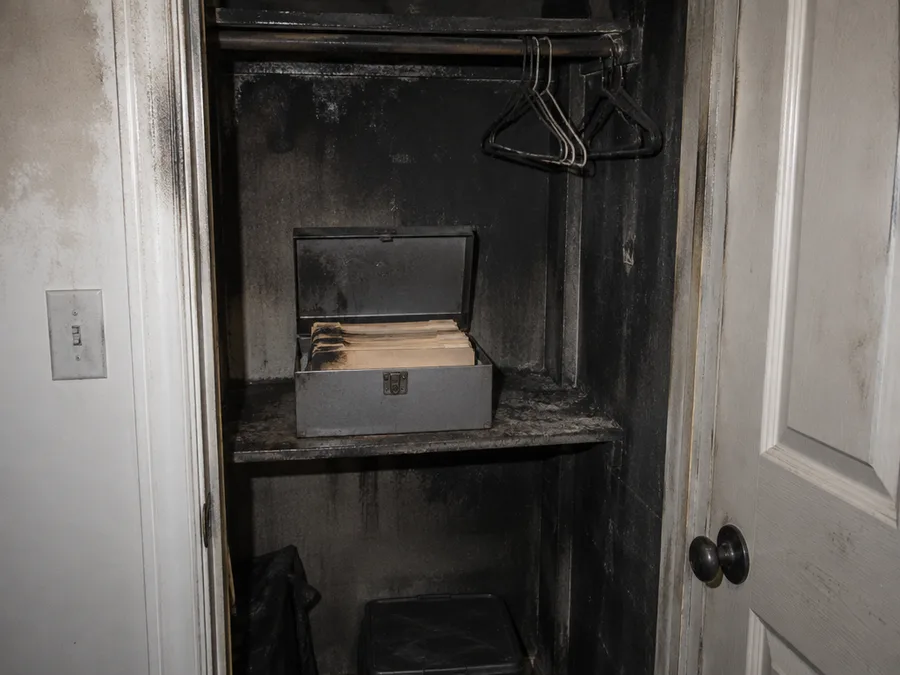
Finding your valuable documents and records is on the Fire Administration's checklist, and After the Fire lists the papers people most often have to replace: driver's licenses, Social Security and Medicare cards, passports, birth, marriage and death certificates, titles and deeds, insurance policies, wills, and tax records, among others. Here is where to start on a few of them.
- The Social Security Administration says a replacement card is free, and that you may not need one at all if you know your number, because in most cases the physical card is not required.
- After a natural disaster, the California DMV replaces licenses, ID cards, registrations, titles, license plates and stickers free of charge at the Local Assistance Centers it runs with Cal OES, and at DMV offices for residents affected by natural disasters. For a single house fire, check the fee with the DMV.
- Handle burnt cash as little as possible and wrap each bill in plastic. The Fire Administration says money that is at least half intact can be taken to a Federal Reserve Bank, and your own bank can tell you which one is nearest. You can also send burnt money to the Treasury's Bureau of Engraving and Printing.
Keep a note of the date and time of the fire and the fire incident report number. You will need both again below.
California rules that apply after a house fire
The national guides that rank for this question stop here, because the next three sections are California and San Diego County rules. Some of California's claim protections apply to every fire, and some apply only when the fire was part of a declared state of emergency, such as a large wildfire. Which kind your loss was changes what you can ask for.
For every claim, the Department of Insurance's regulations set deadlines the insurer has to meet once you report the loss, and our insurance claim guide lists them with their sources.
If your fire was part of a declared state of emergency, the Department's 2026 notice of significant California laws adds more. After a total loss of your main home, the insurer has to accept a contents inventory that groups items into categories, such as clothing, shoes or books, where listing every item would be impractical. It cannot insist on its own inventory form if yours carries substantially the same information. And if you claim living expenses after a total loss, it has to advance at least four months of them when you ask. The Department's 2025 alert on living expenses adds that after a state of emergency that coverage lasts at least 24 months, with extensions for delays you cannot control, although some policies have a dollar limit that can run out first.
A kitchen or electrical fire that damages one house is not a state of emergency. For that fire, your own policy's terms decide these points, so ask the insurer in writing how it handles inventories and living expenses.
Property tax relief from San Diego County
Under section 170 of California's Revenue and Taxation Code, the San Diego County Assessor can temporarily lower the assessed value of a home damaged or destroyed by a fire that was not the owner's fault. Property tax is figured from that assessed value.
The county's conditions are short:
| Condition | What the Assessor says | Source |
|---|---|---|
| Amount of damage | More than $10,000 | San Diego County Assessor, Disaster Relief page, read Sep 26, 2026 |
| Deadline | Apply within 12 months of the day the damage happened | Same page; Rev. & Tax. Code §170 |
| Fault | The damage cannot be the owner's fault | Same page |
| Evidence | Proof of the date and the cost of repair, such as official damage reports, including fire department reports | Same page |
The relief covers the real property, not household furnishings. The Assessor's page also describes a separate rule under Proposition 19 that lets an owner move a home's tax base to a replacement property, but only after a disaster the Governor has declared.
Getting the fire report and permits in Chula Vista
The county asks for a fire department report, and your insurer is likely to want one too. The Chula Vista Fire Department handles records through a Record Requests page on the city's website, where it says it complies with any legal record request. That is where to ask for the report on a fire it responded to. The Fire Administration's booklet has a line for the fire incident report number, and having it makes every later request easier.
Rebuilding needs the city as well. The City of Chula Vista's Development Services department says building permits and inspections are required for new construction, additions and remodeling, and that most repairs or alterations need a building permit. Demolition has its own permit category. Ask about permits before any permanent repair starts, and remember the Department of Insurance's advice to wait until the adjuster has seen the damage.
Help for Chula Vista families after a house fire
If you have no insurance, or not enough, the U.S. Fire Administration suggests turning to family and community. It lists the American Red Cross, the Salvation Army, religious organizations, public agencies such as the public health department, community groups, the state or city emergency services office, and nonprofit crisis counseling centers. The Red Cross chapter linked above serves San Diego and Imperial Counties.
The booklet's advice for you, rather than the house, is to get plenty of rest, ask for help and not try to do it all alone. It also suggests checking with an accountant or the IRS about tax benefits for people recovering from a fire loss.
When you are ready for the house itself, the cleanup is usually a restoration company's job. What drives the bill is on our fire damage restoration cost page, and what can be saved from the smoke is on the soot removal page. Tell us what happened using the form on this page, and we will connect you with a local fire restoration company that serves Chula Vista.