The rules below come from the Department of Insurance's residential property claims guide (Form 405, revised February 28, 2025), its guidance to adjusters, and the California Insurance Code. For what the restoration work itself involves, see our guide to fire damage restoration in Chula Vista.
Does homeowners insurance cover fire damage in California?
Check before assuming. California lets insurers sell residential policies that leave fire out, and since July 1, 2021 such a policy must print THIS POLICY DOES NOT COVER THE PERIL OF FIRE on its declarations page, according to the Department of Insurance's 2026 notice of significant laws. The declarations page is the first thing to read. If you do not have your policy, the Department's tips for wildfire claimants say the law requires your insurer to provide a complete copy free of charge within 30 days of your request.
A homeowners claim is usually paid in separate parts. The Department says a loss that hits both the house and your belongings generally produces two checks, plus a separate one for living expenses. United Policyholders explains that smoke damage to the structure (walls, studs, wall-to-wall carpet) comes out of dwelling coverage, while smoke damage to rugs, clothing, curtains and furniture comes out of contents coverage.
How a fire insurance claim works in California
The Department's claims guide sets out the order. What comes before the first call to the insurer, such as a safe place to sleep and the fire department's all-clear, is in our guide to what to do after a house fire.
- Protect the property. Make temporary repairs to prevent further damage, such as plastic sheeting or plywood over openings in the roof, walls, doors and windows. A policy may not cover later damage if reasonable steps were not taken. The insurer reimburses reasonable costs of protecting the property if you keep the receipts, and those payments are part of the total settlement. Our home page covers what board-up involves.
- Report the loss. Ask whether the policy covers the damage, how long the claim should take, whether you need repair estimates, and what your deductible is.
- Document everything. Photograph the damage, list damaged items with brand names and model numbers, and do not throw anything out until the adjuster says so. Keep a log of every call and letter.
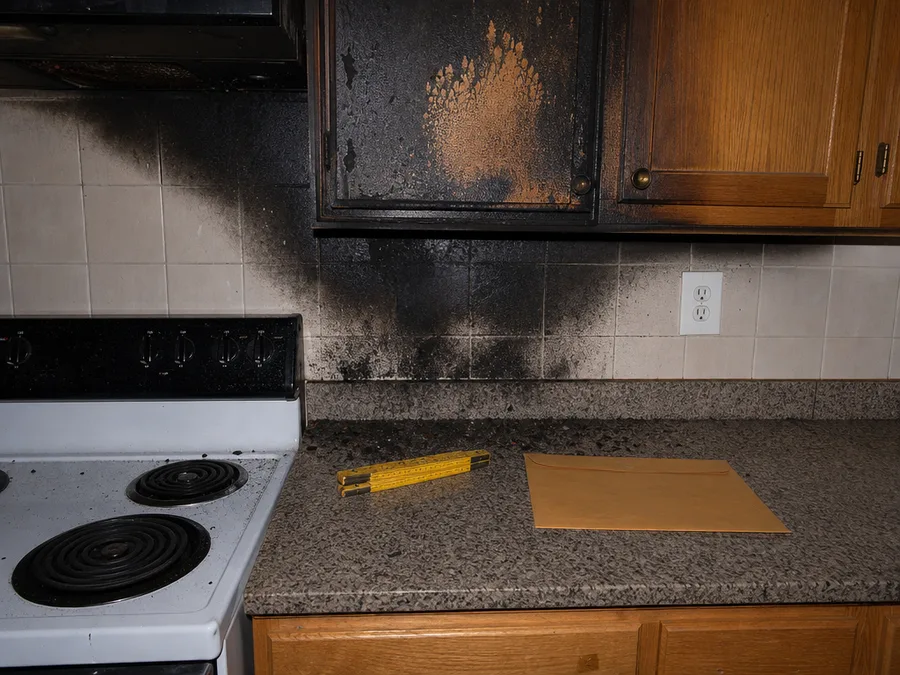
- Meet the adjuster. The adjuster may do a brief first inspection, called scoping the loss, and come back to finish it. The scope notes how bad the damage is, what grade of materials and work went into the house, and the raw measurements a price is later built from.
- Hold off on permanent repairs until the adjuster has seen the damage.
| Rule | What it says | Source, and the date it was checked |
|---|---|---|
| Acknowledge the claim | Within 15 calendar days of notice | 10 CCR 2695.5(e), quoted in CDI's adjusting guide dated Jan 5, 2024. Checked Sep 26, 2026 |
| Accept or deny | Within 40 calendar days of proof of claim, or written notice of what is still needed, updated every 30 days | 10 CCR 2695.7(b) and (c), same guide. Checked Sep 26, 2026 |
| Pay | Within 30 days of accepting the claim in whole or in part | 10 CCR 2695.7(h), same guide. Checked Sep 26, 2026 |
| Collect full replacement cost | No less than 12 months from the first actual cash value payment; no less than 36 months after a state-of-emergency loss | Insurance Code 2051.5(b), CDI notice dated Jan 9, 2026. Checked Sep 26, 2026 |
| Living expenses after a state-of-emergency loss | At least 24 months, extendable to 36 for delays outside your control | Insurance Code 2060(b), same notice. Checked Sep 26, 2026 |
A denial has to be in writing and give its reasons, and it has to tell you the Department of Insurance can review the claim. The Department's guide also warns against early offers presented as full settlements that require you to release further liability, and says a claim can usually be reopened if more damage turns up. For repairs, the Department suggests written bids that list materials and prices line by line, and our restoration cost page explains what drives those prices.
Additional living expenses while you are out of the house
If the house is not safe to live in, keep receipts for what relocating costs you. The Department lists housing and food, extra transportation to work or school, storage, furniture rental and utility installation at a temporary home as expenses the loss-of-use part of a policy may cover, and says insurers usually advance money for them. Any advance counts toward the final settlement.
How long that coverage lasts depends on the policy, except after a declared state of emergency. For those losses, Insurance Code section 2060 sets at least 24 months, with up to 12 more if rebuilding is delayed by things you cannot control. On request, the insurer must also give you a list of the living expenses it believes the policy may cover. Unless your fire was part of a declared state of emergency, the limits in your own policy are what apply.
Smoke damage insurance claims
Smoke-only claims have their own guidance. In Bulletin 2025-7 (March 7, 2025), the Department of Insurance told insurers that recent court cases did not make smoke damage uncovered as a matter of law, and that it can be covered where a policy insures against "direct physical loss of or damage to" property. Whether a given claim is covered depends on the policy wording and the facts. The bulletin says an insurer may not reasonably deny a smoke claim without an appropriate investigation or make the policyholder pay heavily to investigate their own claim, and that where professional testing is warranted the Department expects the insurer to pay for it. It applies to every insurer, the FAIR Plan included.
United Policyholders lists the usual points of disagreement: whether surface cleaning is enough, whether an item can be cleaned or has to be replaced, and whether particles remain that nobody can see. The physical side of that, from dry sponging to ozone, is on our soot removal page.
After the January 2025 Los Angeles fires, the Department convened a Smoke Damage Claims and Remediation Task Force, which reported in March 2026 that more than 13,000 of the more than 40,000 claims from those fires involved standing homes with smoke damage. In February 2026 the Insurance Commissioner announced AB 1795, a proposed bill for statewide smoke testing and restoration standards. Check its current status with the Department before relying on it.
The California FAIR Plan and fire claims
The FAIR Plan is for people who cannot get insurance through a regular company. The Department's FAIR Plan page describes it as a private association created by the Governor and Legislature, run day to day by insurance companies, and says its current residential policy is a limited fire policy. The Department notes that coverage such as water damage, liability, theft and additional living expenses comes from a separate Difference in Conditions policy while a comprehensive FAIR Plan option is developed. If the FAIR Plan insures your home, the Department's smoke bulletin applies to it like any other insurer.
Soot, cost and the rest of the work are on our services page, and a question about this guide itself can go through the contact page.